Begin with the dishes the oven must produce during the busiest service. Include preparation done before service, baking, roasting and any reheating process that forms part of your approved kitchen procedures.
Understand the main difference
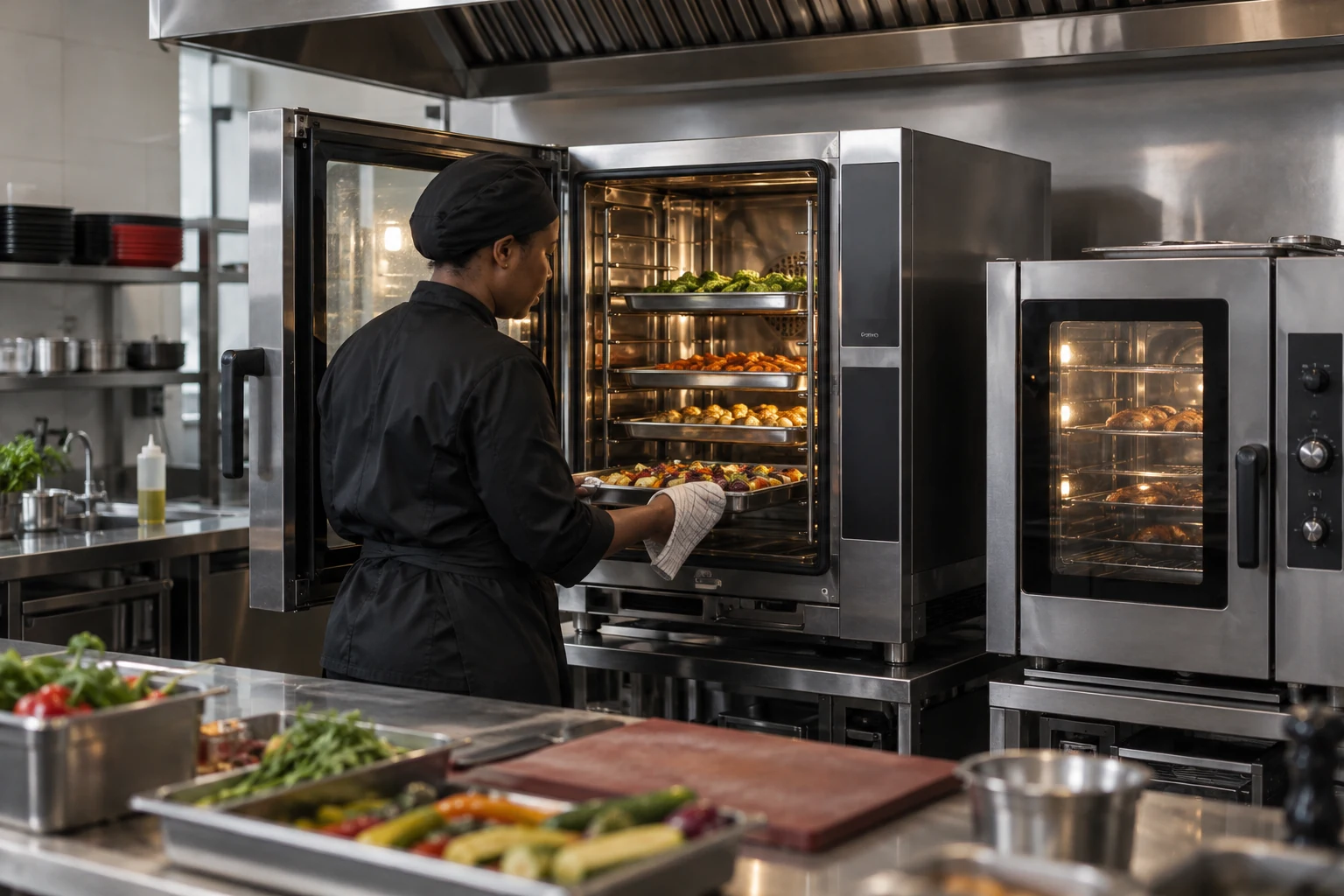
A convection oven primarily cooks using circulated hot air. A combi oven adds steam cooking and combinations of steam and hot air, with the available modes and controls depending on the model.
RATIONAL’s operating instructions describe separate steam, convection and combined modes. That distinction explains the additional flexibility, but it does not mean every kitchen needs all of those modes or that all combi ovens have the same features.
Match the oven to real menu tasks
A kitchen focused on straightforward baking or roasting may find a suitable convection oven meets its needs. A kitchen preparing a wider variety of food may benefit from the control over heat and humidity available on an appropriate combi model.
Write a test menu for the supplier discussion. Ask how the shortlisted oven handles the foods you actually plan to serve, which accessories are needed and how staff will repeat the process consistently. Avoid choosing from a list of cooking modes without connecting them to the menu.
Compare usable tray capacity
Check tray format, rack spacing, loading height and the dimensions of the food or containers. The number of levels does not automatically equal the number of usable trays for every recipe.
Also assess simultaneous production. Two dishes may need different conditions and therefore cannot necessarily share the same cooking cycle. Review how your production schedule will use the oven before assuming that a larger unit solves every capacity issue.
Include site services and installation
An oven’s position must allow safe loading, door opening, cleaning and maintenance access. Have the relevant contractors confirm the available electrical or gas supply and any extraction requirements.
Combi models may need water supply, drainage and suitable water treatment, depending on their specification. Confirm those requirements with the manufacturer or supplier. A unit that fits physically can still require significant supporting site work.
Ask about cleaning and staff training
Find out which cleaning functions are included, which products the manufacturer approves and which tasks staff must complete manually. Ask what daily checks and scheduled servicing the oven requires.
Training should cover the cooking controls, loading, cleaning and fault reporting. If the team will use only a few standard programmes, establish them during commissioning. More features are useful only when staff understand how to use them for the menu.
Compare the whole proposal
Put these details alongside the quoted appliance price:
- The menu tasks and operating modes you will use.
- Tray sizes, usable capacity and included accessories.
- Power, water, drainage and extraction requirements.
- Installation, commissioning and training responsibilities.
- Cleaning products and ongoing service arrangements.
- Delivery access, placement and warranty conditions.
A carefully selected convection oven can be a sound choice, while the flexibility of a combi oven can justify a broader role in another kitchen. Ask for an equipment recommendation that explains the connection between the model and your production needs.
Frequently asked questions
Can a combi oven cook with dry heat?
Many combi ovens include a convection or hot-air mode. Check the available modes and controls on the exact model.
Does a convection oven require the same water services as a combi oven?
Not necessarily. Requirements differ by appliance design. Confirm water, drainage and other connections from the selected model's installation documentation.
Further reading
These sources provide background guidance. Check the documentation for the exact equipment you intend to buy.
Featured image is an AI-generated illustration of a kitchen or equipment setting.